How Uncontested Google Ads Quietly Waste Your Marketing Budget

Understanding the Google Ads Auction
Many businesses invest in Google Ads expecting that higher costs are simply the price of competition. As more companies move their marketing budgets online, cost-per-click (CPC) prices continue to rise across industries.
But there’s a lesser-known issue that can quietly drain marketing budgets: uncontested Google Ads auctions.
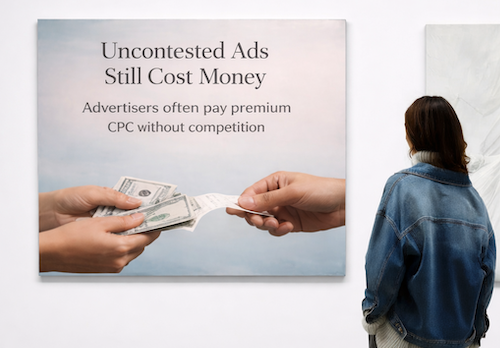
In many cases, businesses are paying premium prices for clicks even when no other advertisers are bidding on the same keyword.
Understanding how this happens—and how to correct it—can dramatically improve the efficiency of your Google Ads campaigns.
Google Ads operates as a real-time auction. Every time a user performs a search, Google runs an automated auction to determine which ads appear and in what order.
BrandPilot AI illustrates this concept with a useful analogy: imagine participating in an auction while blindfolded. You continue raising your bidding paddle as prices increase, assuming other bidders are competing for the same item. But what if no one else is bidding at all?
This is similar to what can occur in Google Ads. Advertisers frequently increase bids in order to maintain visibility, but they often have limited insight into whether competitors are actively bidding in that moment.
The result is that companies may continue paying high CPC prices even when competition temporarily disappears.

How the Google Ads Auction Actually Works
When someone searches on Google, several factors determine which ads appear and how much advertisers ultimately pay for a click.
Six key elements influence the auction:
1. Your Bid
The maximum amount you are willing to pay for a click.
2. Ad Quality and Landing Page Experience
Google evaluates the relevance of your ad and the quality of the landing page it leads to.
3. Ad Assets and Extensions
Additional elements such as call extensions, sitelinks, and structured snippets can improve performance.
4. Ad Rank Thresholds
Minimum quality standards must be met for an ad to appear in certain positions.
5. Context of the Search
Location, device type, time of day, and other user signals influence the auction.
6. Competition
The number and strength of competing advertisers bidding on the same keyword.
In a typical competitive auction, multiple advertisers bid against one another, and Google determines placement based on a combination of bid price and ad quality.
However, when competition is absent, something interesting happens.

What Are Uncontested Google Ads?
Uncontested Google Ads occur when an advertiser appears in the auction with little or no competition for a keyword.
In theory, this should reduce the cost of clicks. However, in many campaigns, advertisers continue paying relatively high CPC prices because automated bidding systems are still optimizing for visibility rather than minimizing cost.
This can lead to situations where companies are effectively bidding against themselves.
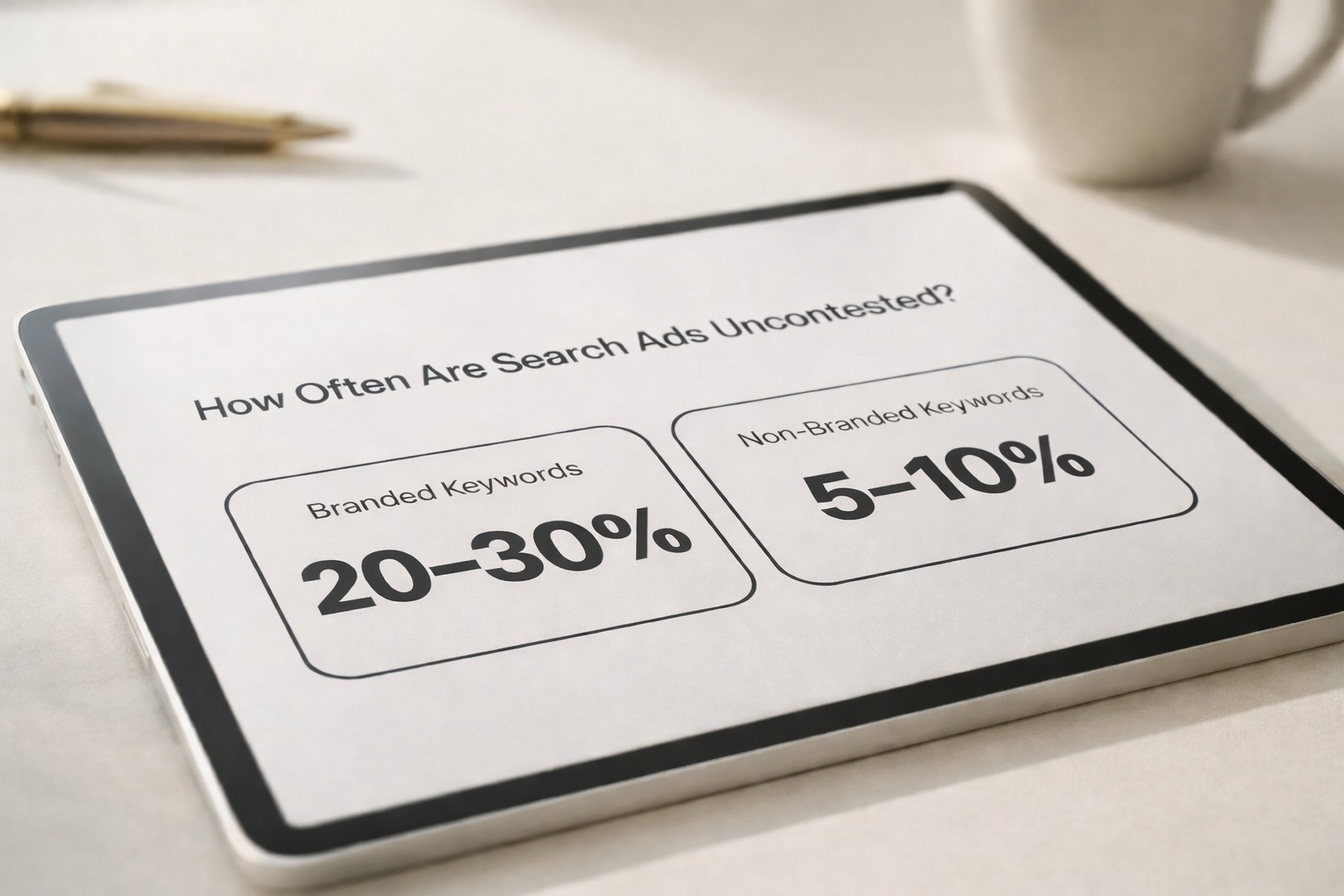
How Often Does This Happen?
Many marketers assume uncontested auctions are rare, but research suggests they occur more frequently than expected. Industry data indicates:
20–30% of branded keyword auctions have no competition
5–10% of non-branded keyword searches experience periods without competing ads
20–30% of Google Shopping auctions may also lack active competition
For businesses running large ad budgets, this means a significant portion of their spend may be occurring in auctions where there are no other bidders present.
Whatever it is, the way you tell your story online can make all the difference.

The Scale of Wasted Ad Spend
To understand the broader impact, consider the size of the search advertising market.
Google’s search advertising revenue reached approximately $264 billion in 2024.
Of that total:
Roughly 18% of budgets are spent on branded keywords
Approximately 82% is spent on non-branded keywords
If even a portion of these auctions occur without competition, billions of dollars may be spent inefficiently each year.
Some industry estimates suggest that advertisers could be overspending tens of billions annually due to inefficient bidding strategies.
Why Businesses Overspend on Google Ads
Several factors contribute to this problem.
Automated Bidding Strategies
Many campaigns rely on automated bidding systems that prioritize visibility and conversions rather than minimizing cost during low-competition auctions.
Lack of Auction Monitoring
Businesses often launch campaigns and rarely review detailed auction insights, leaving inefficiencies unnoticed.
Over-reliance on Branded Keyword Ads
While branded campaigns are important for protecting search visibility, they should be managed carefully to avoid unnecessary spend.

How Companies Are Reducing Wasted Ad Spend
Advertisers who actively manage auction dynamics can significantly reduce CPC while maintaining traffic.
Here are several strategies that are becoming more common.
1. Create Multiple Versions of Your Ads
Instead of running a single campaign structure, some advertisers create:
A standard competitive campaign
A low-bid campaign designed for moments of low competition
This allows bids to decrease when competition disappears while maintaining visibility when competitors enter the auction.
2. Monitor Auction Insights
Google Ads provides detailed Auction Insights reports that reveal how frequently competitors appear in the same auctions.
Key metrics include:
Impression share
Overlap rate
Top-of-page rate
Outranking share
These insights help advertisers understand where competition is strongest and where bidding may be unnecessary.
3. Gradually Reduce CPC Bids
Lowering bids gradually allows campaigns to maintain performance while improving efficiency.
For example:
$1.39 → $1.02 → $0.72
Over time, Google’s bidding systems adjust to the lower CPC environment.
4. Use Negative Keywords Strategically
Negative keyword lists help prevent ads from appearing in irrelevant searches or competitive auctions where another advertiser consistently dominates.
This ensures budget is allocated to searches where your business has a stronger chance of converting.

Why Conversion Optimization Matters
Lower CPC is only part of the equation. The ultimate goal of any Google Ads campaign is improving return on ad spend (ROAS).
This requires optimizing both:
the advertising campaign
the landing page experience
Businesses that invest in conversion optimization often see dramatically better results from the same advertising budget.

Improving Google Ads Efficiency
Google Ads remains one of the most powerful digital marketing platforms available. However, rising competition and automated bidding strategies mean that many campaigns operate inefficiently without careful oversight.
By analyzing auction dynamics, adjusting bidding strategies, and improving conversion performance, businesses can often recover a meaningful portion of their advertising budget.
In many cases, these improvements translate into lower CPC, stronger lead quality, and higher overall return on ad spend.
Uncontested Google Ads auctions represent a hidden inefficiency in many campaigns. While they are rarely discussed publicly, they can have a significant impact on marketing budgets over time.
Businesses that take the time to monitor their campaigns closely—and adjust strategies when competition is absent—can unlock meaningful savings while maintaining strong visibility in search results.
