The CMO’s Comeback: How High-Performing Leaders Move Beyond the Linear Marketing Funnel

Modern Consumer Behaviour No Longer Moves in Stages
Marketing has reached a paradigm-shifting moment.
Digital transformation fractured consumer journeys long before AI entered the conversation. Discovery, evaluation, and decision-making now occur across overlapping environments rather than predictable steps. The rapid acceleration of AI will only intensify this complexity — compressing time, multiplying touch points, and reshaping how influence is created.
But AI is not simply a source of disruption.
It is an opportunity.
An opportunity to move beyond inherited models, rethink how influence is generated, and design marketing systems aligned with how people actually behave — not how funnels assume they should.
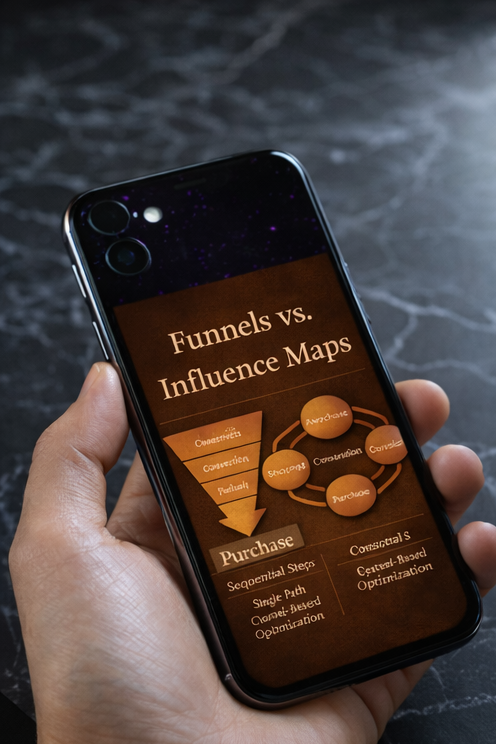
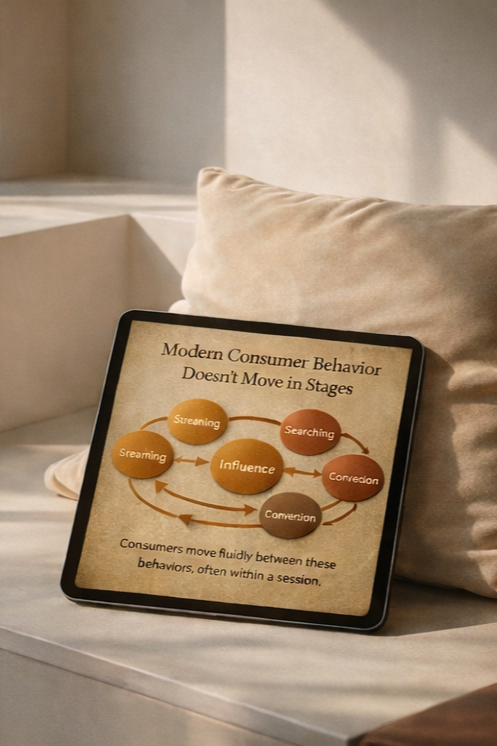
Recent research from Boston Consulting Group describes modern consumer behaviour through four dominant modes: streaming, scrolling, searching, and shopping.
These are not stages in a journey.
They are behavioural states.
Consumers move between these modes fluidly, often within a single session, across multiple platforms and devices. Discovery may happen while streaming video. Evaluation may occur while scrolling social feeds. Search, validation, and transaction can collapse into the same moment.
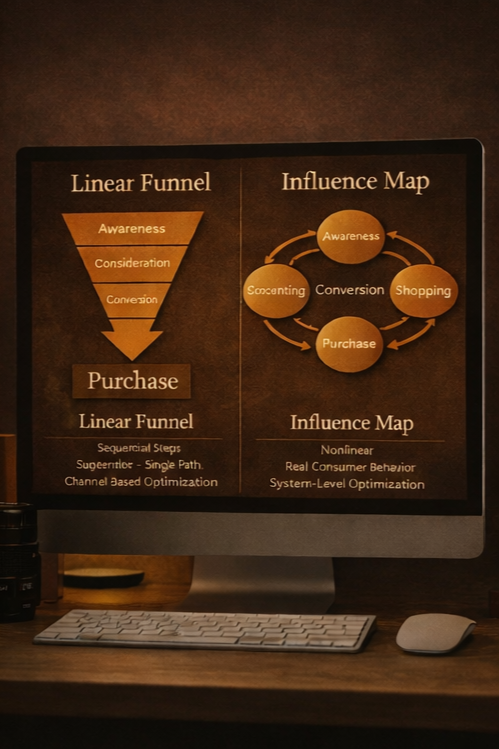
This behaviour directly challenges the assumptions of the traditional marketing funnel, which was built on sequential progression — awareness to consideration to action. In practice, influence now accumulates across overlapping touch points rather than advancing through linear steps.
Despite this shift, many organizations continue to force-fit modern behaviour into legacy funnel models to guide strategy, budget allocation, and measurement. The result is a growing disconnect between how people actually buy and how marketing performance is interpreted.
High-Performing CMOs Design Systems, Not Funnels
This disconnect is addressed directly in research from McKinsey & Company, where Robert Tas, Partner, and Kelsey Robinson, Senior Partner, identify a defining trait of high-performing CMOs: they design marketing systems that reflect real consumer behaviour rather than inherited models.
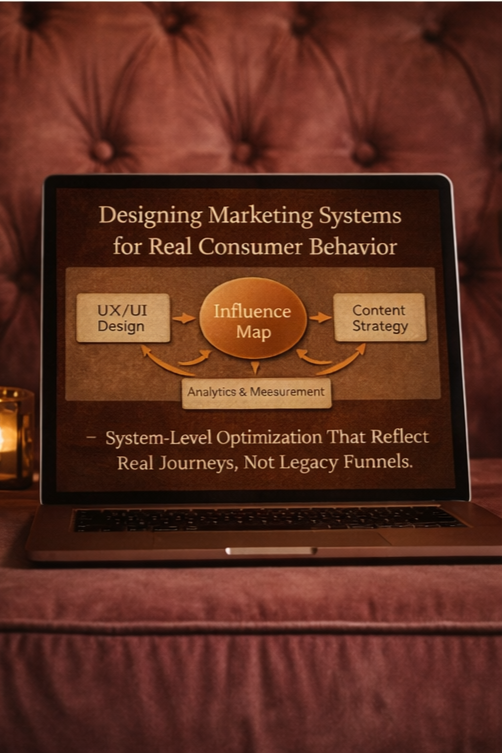
Rather than optimizing isolated campaigns or channels, these CMOs operate with a general-manager mindset. They focus on how marketing infrastructure supports growth, decision-making, and measurable business outcomes. UX, content, media, analytics, and measurement are treated as interdependent components of a single system.
McKinsey’s findings show that when CMOs are embedded in strategic decision-making and aligned with how customers actually navigate information, organizations outperform peers. Marketing shifts from a variable expense to a growth engine — not by doing more, but by designing systems that match how influence is created.
From Linear Funnels to Influence Maps
Historically, marketers relied on the funnel to assign touch points to stages. Channels were mapped to awareness, consideration, or conversion. Performance was evaluated by how efficiently users moved from one step to the next.
BCG’s concept of the influence map reframes this logic entirely.
An influence map reduces artificial barriers between stages and measures degree of influence rather than sequence. A single interaction — a YouTube video, a social post, a search result — can contribute to awareness, consideration, and action simultaneously.
Influence accumulates across touch points instead of transferring cleanly from one stage to another.
This distinction matters because optimization strategies depend on how journeys are modeled. Funnel thinking encourages channel-level optimization. Influence-based thinking requires system-level design.
AI now makes this model operational. Real-time signals, behavioural clustering, multimodal search, and adaptive execution allow marketers to respond dynamically to how consumers are actually engaging — not how they were expected to move.

Why Attribution Breaks in a Nonlinear World
As buying behaviour became more complex, marketing systems responded by adding more channels, more dashboards, and more metrics. In theory, this should have improved clarity.
In practice, it created confusion.
Attribution models assume influence can be cleanly assigned. Modern journeys distribute influence.
Buyers enter through multiple touch points. AI-driven discovery compresses research and action. UX structure, content clarity, trust signals, and timing shape conversion as much as campaigns do — yet these elements remain underrepresented in reporting frameworks.
This is why debates around brand versus performance persist. The distinction made sense in a linear world. In today’s environment, it collapses under real behaviour.
What’s missing is not more data — but a framework aligned to how decisions are actually made.
What Replaces the Funnel Model
The funnel is not replaced by another diagram.
It is replaced by infrastructure thinking.
Modern marketing systems are designed to:
Support multiple entry points
Serve different intent states simultaneously
Reduce friction regardless of arrival context
Measure incremental impact rather than isolated actions
Pages are structured to absorb discovery, validation, and decision-making in parallel. SEO functions as a foundational layer across traditional and AI-driven search. UX anticipates nonlinear movement. Measurement prioritizes outcomes over channel activity.
This is where influence maps become actionable — and where AI enables real-time adaptation based on observed behaviour rather than assumed journeys.
The CMO’s Comeback Is a Systems Shift
McKinsey’s research points to a broader organizational reality: when everyone is responsible for the customer, no one truly is.
High-performing CMOs reclaim their seat at the table by becoming the custodian of the customer system — deeply fluent in behaviour, data, experience, and outcomes. They align with finance. They design measurement frameworks collaboratively. They stop activities that don’t work and scale what does.
Organizations that enable this alignment grow faster than peers. Those that continue to evaluate marketing through linear frameworks increasingly struggle to justify investment.

How RSC Digital Marketing Operationalizes the Influence Map
At RSC Digital Marketing, we act as a strategic consulting growth partner, helping organizations audit, implement, and guide business development and lead-generation systems grounded in real consumer behavior.
Our programs are designed to:
Analyze how users move across multiple touchpoints
Identify where influence accumulates — not just where clicks occur
A/B test UX, content, and messaging against observed behaviour
Map heatmaps, entry points, and decision paths across pages
Build UX/UI landing page and content systems designed to absorb traffic from streaming, scrolling, searching, and shopping environments simultaneously
Our work is informed by the BCG influence-map model and operationalized through AI-driven execution. Rather than forcing users into artificial journeys, we design environments that support multiple intent states at once — improving clarity, reducing friction, and increasing conversion without oversimplifying behaviour.
RSC Digital Marketing: Digital Strategy, UX Architecture, SEO, and AI-Driven Conversion Systems
The marketing funnel did not fail because marketing execution declined. It failed because the behavioural assumptions it rests on no longer hold.
As consumer journeys become fluid and influence becomes distributed, marketing systems must be designed holistically and measured accordingly. The next phase of digital growth will not be driven by additional channels or dashboards, but by coherent systems that align behaviour, experience, and accountability.
The CMO’s comeback is not about doing more marketing.
It’s about designing better systems for how people actually decide.
At RSC Digital Marketing, we translate behavioural complexity into structured digital environments — aligning UX, semantic SEO, AI-driven discovery, and measurement into unified systems built for how people actually buy.
Consultations for UX & Cognitive Architecture, LLM-Aligned Landing Pages, and Semantic SEO & GEO Strategy are available upon request.
